Troubleshooting Common Engine Noises and What They Signal
Decode rattles, knocks, squeals, and hisses. Learn what common engine noises mean, how urgent they are, and the fixes to keep you safely on the road.
Knocking or Pinging Under Load
A sharp, metallic knocking or pinging that appears during acceleration, uphill climbs, or when the engine is under heavy load often points to detonation or pre-ignition. This happens when the air-fuel mixture ignites unevenly or too early, creating shock waves that sound like marbles rattling in a can. Common triggers include low-octane fuel, carbon deposits that raise effective compression, a lean mixture from vacuum leaks, or overly advanced ignition timing. Overheating and malfunctioning EGR or knock sensors can also contribute. Differentiate this noise from a deep, rhythmic rod knock, which usually grows louder with RPM and persists even off-throttle. If you hear persistent pinging, ease off the throttle and avoid lugging the engine. Verify the correct fuel grade, check for vacuum leaks, inspect the cooling system, and scan for stored fault codes. Addressing detonation promptly prevents piston damage, bearing wear, and costly repairs, making this a high-priority noise to investigate.
Ticking or Clicking from the Top End
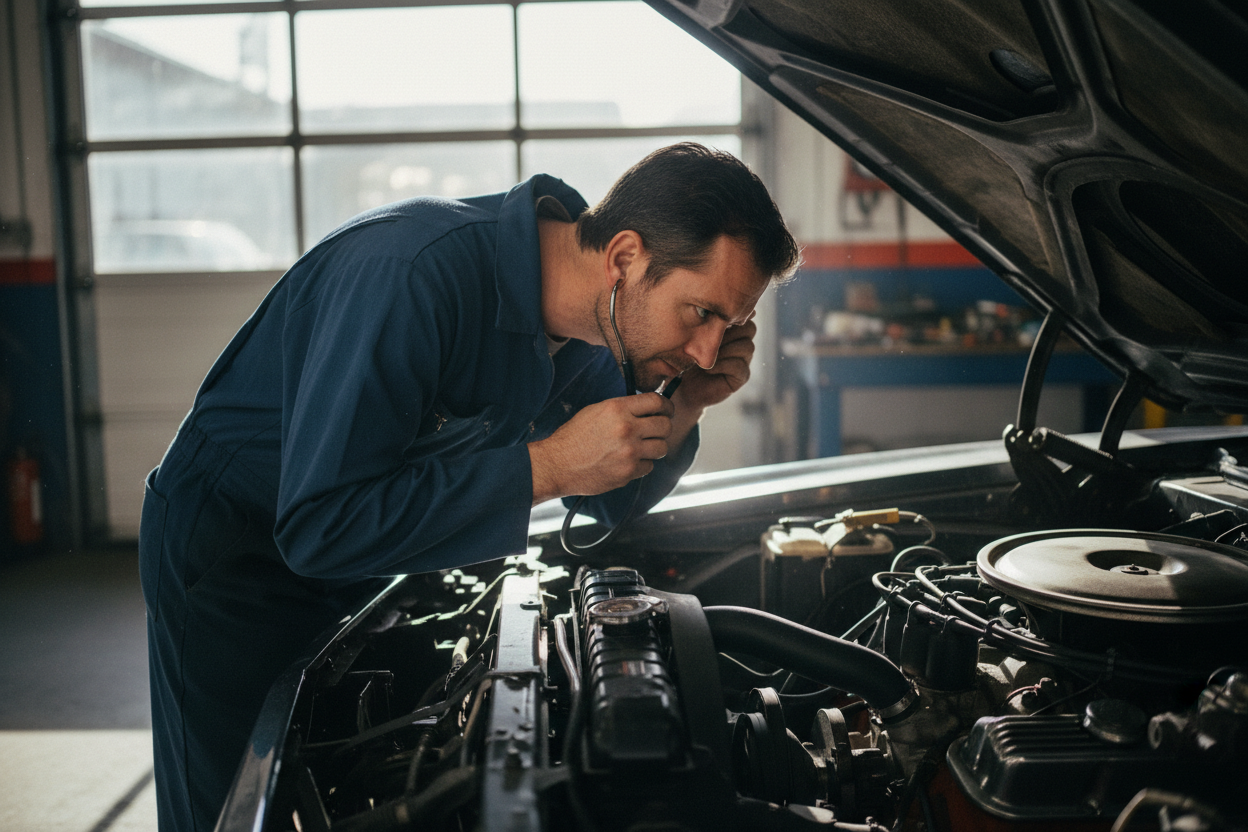
A rapid ticking or clicking from the top of the engine often originates in the valvetrain—think hydraulic lifters, rockers, or cam followers—and typically rises with RPM. Low oil level, incorrect oil viscosity, sludge, or a sticking lifter can reduce lubrication and cause a tick that may quiet as oil pressure builds. Differentiate this from fuel injector tick, which is usually a light, rhythmic tapping that's normal and uniform across cylinders. A leaking exhaust manifold or header gasket can also mimic a tick, especially noticeable on cold start and softening as metals expand. Start by verifying oil level and quality, listening at the valve cover with a mechanic's stethoscope (or a long screwdriver), and noting changes between cold and warm operation. If the oil pressure light flickers or the tick becomes loud and metallic, stop driving and diagnose immediately. Regular oil changes, the correct viscosity, and timely filter replacements help prevent valvetrain noise and premature wear.
Squealing on Startup or Acceleration
A high-pitched squeal when you start the engine or blip the throttle usually indicates belt slip on the serpentine belt or accessory pulleys. A glazed belt, weak tensioner, misaligned pulley, or contaminated belt surface reduces friction. The sound may spike when you switch on the A/C, turn the steering wheel (adding power steering load), or accelerate from idle. Failing idler or tensioner bearings, and even a seizing alternator or water pump, can also squeal before progressing to harsher noises. Diagnosis starts with a visual check for belt cracks, glazing, fraying, or rubber dust near pulleys. Watch the tensioner arm; excessive flutter suggests weak spring force. A brief mist of water on the belt that quiets the noise points to slip; if the squeal persists, suspect a bearing. Avoid applying dressings that mask the problem. Replacing the belt and tensioner together is often wise. Address promptly—accessory failure can cause overheating, loss of charging, or sudden breakdowns.
Grinding or Growling from the Front of the Engine
A coarse grinding or growling from the engine's front typically signals failing accessory bearings or internal timing components. Worn idler or tensioner bearings, a failing water pump, alternator, or A/C compressor clutch can produce a dry, abrasive tone that increases with RPM. If the engine uses a timing chain, damaged guides or a failing chain can add a grinding undertone, sometimes accompanied by a rattle on startup. One method to isolate the source is briefly removing the serpentine belt (engine off to remove, then start for only a few seconds). If the noise disappears, the culprit is belt-driven; if it remains, consider timing components. Spin each pulley by hand and feel for roughness or play; any gritty rotation or wobble means replacement. Do not run without coolant flow or charging for more than a few seconds during tests. Treat grinding as urgent—bearing failure can seize accessories, shred belts, and cascade into overheating or electrical loss.
Hissing, Sucking, or Whistling from the Engine Bay
A persistent hiss, sucking, or whistling suggests a vacuum leak or intake tract issue. Cracked vacuum hoses, a split intake boot, a failing PCV hose, or loose throttle body gaskets can admit unmetered air, often causing rough idle, higher-than-normal idle speed, or lean mixture codes. A whistle that changes with throttle may point to intake leaks or a partially blocked passage. On turbocharged or supercharged setups, a sharp whoosh or whistle under boost can indicate a boost leak, while a faint siren-like tone may be normal turbine noise; sudden changes, however, deserve attention. A coolant leak can also hiss as it flashes to steam on hot components and often carries a sweet odor. Inspect all hoses and clamps, listen around the intake manifold, and gently move lines to see if the sound alters. A professional smoke test finds elusive leaks quickly. Left unchecked, vacuum leaks lead to poor drivability, elevated combustion temperatures, and long-term engine stress.
Rattling at Idle or During Deceleration
A loose, metallic rattle at idle or on decel often points to exhaust heat shields, worn exhaust hangers, or a failing catalytic converter with broken internal substrate. Lightly tapping heat shields with a gloved hand or rubber mallet can reveal a tinny vibration; adding proper clamps or replacing corroded shield fasteners typically eliminates it. A brief timing chain rattle on cold start that fades quickly may be normal wear, but persistent chain noise signals stretched links or worn guides. Inside the cabin, a shaky idle combined with rattles may indicate a failed engine mount, letting vibrations transfer to the chassis. Deceleration-specific rattle could also be spark knock at low RPM in higher gears; downshift to reduce load and investigate fuel quality or ignition issues. Check for loose brackets, shields, and brackets on the exhaust, ensure proper oil level and pressure, and examine mounts for tears or fluid leaks. Address exhaust and mounting issues promptly to prevent escalation and secondary damage.
Deep Whine or High-Pitched Whir
A steady whine or whir that follows engine RPM can arise from the power steering pump, alternator, supercharger, or even the transmission if the sound is transmitted through the bellhousing area. A power steering whine often grows louder when turning the wheel at idle; low or incorrect fluid can intensify it. Alternator bearings can produce a mid-frequency whir that rises with electrical load, sometimes accompanied by dimming lights or a battery warning. On forced-induction engines, a pronounced turbo or supercharger whine may be normal, but sudden increases, scraping overtones, or smoke suggest bearing wear or boost leaks. Differentiate engine-speed-related whine from road-speed-related noises by revving in neutral; if the sound remains, it's likely engine or accessory related. Use a stethoscope to localize the loudest component, keeping clear of moving parts. Correct fluid levels, proper belt alignment, and timely bearing replacements prevent whine from evolving into failure. Treat growing or oscillating whines as early warnings rather than background noise.