Portable Power: Choosing Power Banks and GaN Chargers
Learn how to pick the right power bank and GaN charger: capacity, wattage, USB-C PD, fast-charge protocols, safety, travel rules, and top use cases.
The Basics of Portable Power
Portable energy revolves around two numbers: mAh and Wh. mAh expresses capacity at a given voltage, while Wh expresses total energy, making it the most reliable benchmark for comparison. Because devices negotiate different voltages through USB-C Power Delivery (PD), Wh reveals how much runtime you can truly expect. Real-world results are shaped by conversion efficiency, cable losses, and temperature, so you rarely see every drop of printed capacity. Battery chemistry and energy density influence size and weight, while cycle life determines how many charges the pack can deliver before noticeable wear. Internal thermal management protects cells during fast output or quick recharging. Idle self-discharge and regulator overhead can sip energy even when nothing is connected. Understanding these fundamentals helps you look past marketing claims, align expectations with physics, and choose smarter. Pair the right output wattage to your device's peak draw, and remember that a well-matched bank is often lighter, safer, and more efficient than an oversized one you never fully use.
Choosing a Power Bank
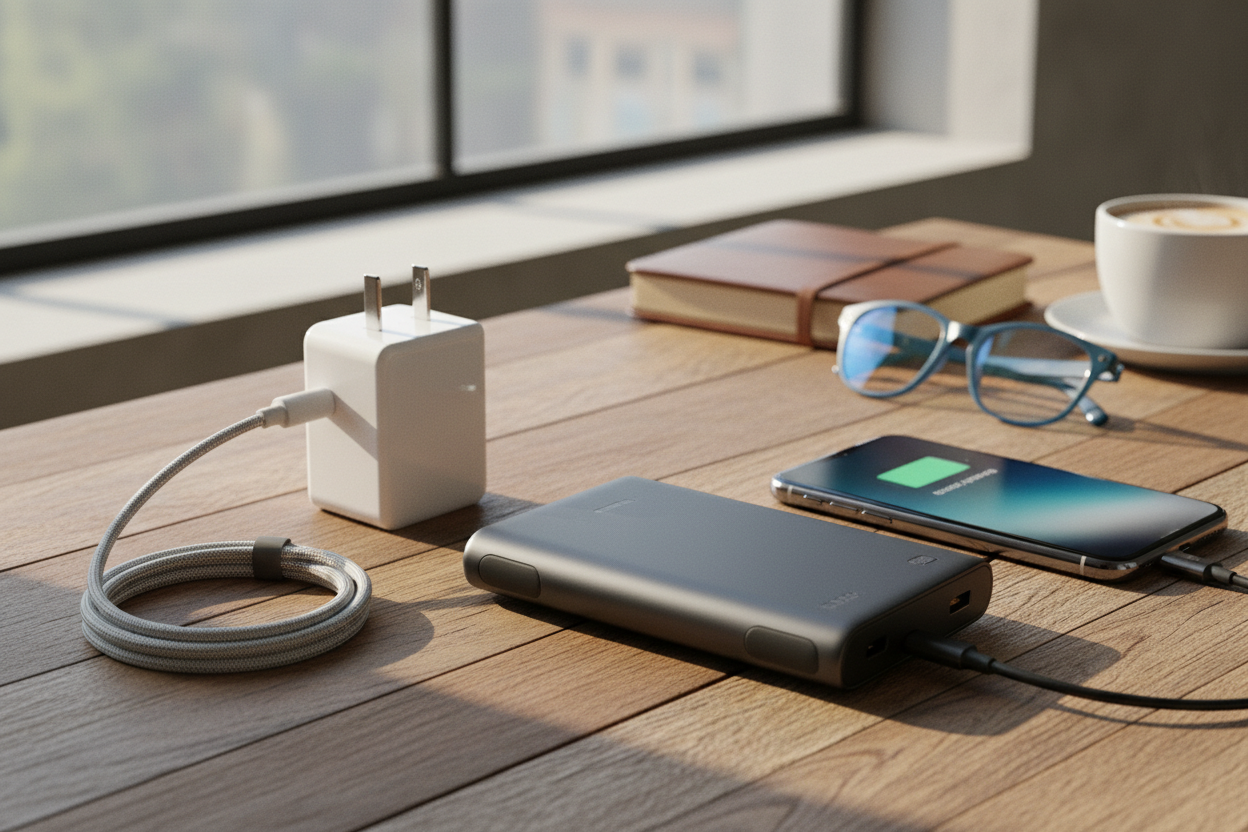
Start by sizing for your routine. Phones and earbuds benefit from slim banks optimized for USB-C PD and low-current trickle modes, while tablets and ultraportables prefer higher Wh with sustained wattage output. Laptops may need banks supporting elevated PD profiles and robust thermal design for long sessions. Look for multiple ports if you charge several devices, and check whether the bank supports pass-through charging for convenience at a desk. An accurate display or clear indicators help track remaining energy and charging status. Consider weight, pocketability, and grip-friendly textures if you travel or commute. Some models add wireless charging, which is convenient but less efficient and warmer than wired connections. For flights, verify the Wh rating printed on the label to comply with airline policies. Durability details—reinforced ports, solid buttons, and reliable cables—pay off over time. A thoughtfully chosen bank balances capacity, port flexibility, and safety features without becoming a brick in your bag.
Why GaN Chargers Stand Out
GaN chargers use gallium nitride transistors that switch faster and waste less energy than traditional silicon designs. The result is higher efficiency, smaller size, and cooler operation under load. That compactness makes multi-port travel bricks practical, with dynamic power sharing that allocates wattage based on each device's needs. Advanced PD features such as PPS and extended ranges enable smoother voltage negotiation, faster ramps, and better thermal behavior for phones, tablets, and many laptops. Look for safeguards such as over-voltage, over-current, and over-temperature protection, plus careful power density engineering that keeps components within safe margins. Folding prongs, interchangeable plug heads, and well-labeled ports enhance everyday usability. When choosing wattage, match the highest peak your device requires, then add headroom for simultaneous charging of a second device. In short, a good GaN charger feels deceptively small for its capability, quietly delivering stable power that respects battery health while keeping your travel kit lean.
Compatibility, Ports, and Cables
Compatibility lives at the intersection of ports, protocols, and cabling. Prioritize USB-C for modern computers and consumer electronics, as it supports PD and, on some chargers, PPS for fine-grained voltage control. Legacy USB-A can still be useful for accessories, but it typically lacks advanced negotiation. Multi-port chargers with intelligent power distribution minimize slowdowns when you plug in additional devices. Cables matter more than many realize: a proper E-marker cable can carry higher current safely, enabling full-speed charging for laptops. Shorter, thicker-gauge cables usually reduce voltage drop, improving stability and heat. Verify whether a cable supports the current and data rate you need—some are power-only, while others enable higher-speed data or video alt modes. Be cautious with adapters and hubs that remap ports, as they can limit available wattage or protocols. When in doubt, test the setup with a trusted USB-C meter to confirm voltage, current, and negotiated profile.
Everyday Scenarios and Sizing Strategy
Plan around your day rather than chasing the biggest number. Commuters might prefer a slim bank for quick top-ups and a compact GaN charger at the office. Travelers can pair a mid-capacity bank for transit with a multi-port wall unit at the hotel, simplifying overnight resets for phone, watch, earbuds, and tablet. Creators and power users may prioritize high Wh banks with stable PD output for cameras or ultraportables, plus longer, robust cables for flexible placement. Outdoor days call for ruggedized finishes and water-resistant ports; indoor desk setups benefit from pass-through charging to keep the bank topped while acting as a hub. Consider the efficiency hit of wireless charging—great for convenience, but wired saves energy and heat. A dual-tool approach—a light everyday bank and a heavier-duty backup—often beats one do-it-all device. Match your wattage to the most demanding device, then let the rest ride on shared capacity without constant swapping.
Care, Safety, and Smart Buying
Quality pays dividends. Look for proven safety features such as OVP, OCP, OTP, and short-circuit protection, along with reputable third-party certifications. Solid enclosures, secure port fit, and crisp labeling reflect good manufacturing. Store power banks partially charged in a cool, dry place, avoid extreme heat or cold, and keep vents or grilles clear on high-output gear. Do not crush packs at the bottom of a bag, and clean ports gently to prevent arcing or intermittent connections. Use appropriate E-marker cables for high-current charging, and replace frayed leads promptly. For longevity, avoid deep discharge cycles when possible and unplug once devices reach full. When buying, compare Wh, wattage, and protocol support rather than chasing only capacity. Steer clear of questionable listings and check warranties. When it is time to retire a pack, bring it to proper battery recycling. Treat your portable power like a tool, and it will quietly power your day for the long haul.