Noise and Vibration: Diagnosing Motor Issues
Learn how to diagnose motor noise and vibration by spotting common symptoms, pinpointing root causes, and applying practical fixes to prevent failures.
Understanding Baseline Signatures: Motors naturally generate sound and motion, but controlled levels of noise and vibration are normal and often predictable. Effective diagnostics begin with a baseline collected under steady load and consistent mounting conditions, so that later deviations stand out. Focus on three primary descriptors: amplitude, frequency, and phase. Rotational frequency, commonly labeled 1X, reflects shaft speed and is a reference for identifying harmonics and sidebands that signal trouble. Beware of resonance, where small forces create large responses due to structural natural frequencies. Distinguish structure-borne vibration from airborne acoustics, since each reveals different behaviors. Some tones are benign, such as the low electromagnetic hum of a healthy motor, while irregular beating, broadband hiss, or rattling may indicate faults. Track how signatures change with speed, load, and temperature; a problem that grows nonlinearly as speed rises often hints at balance or resonance. A clear baseline, plus disciplined trending, forms the foundation for precise diagnosis.
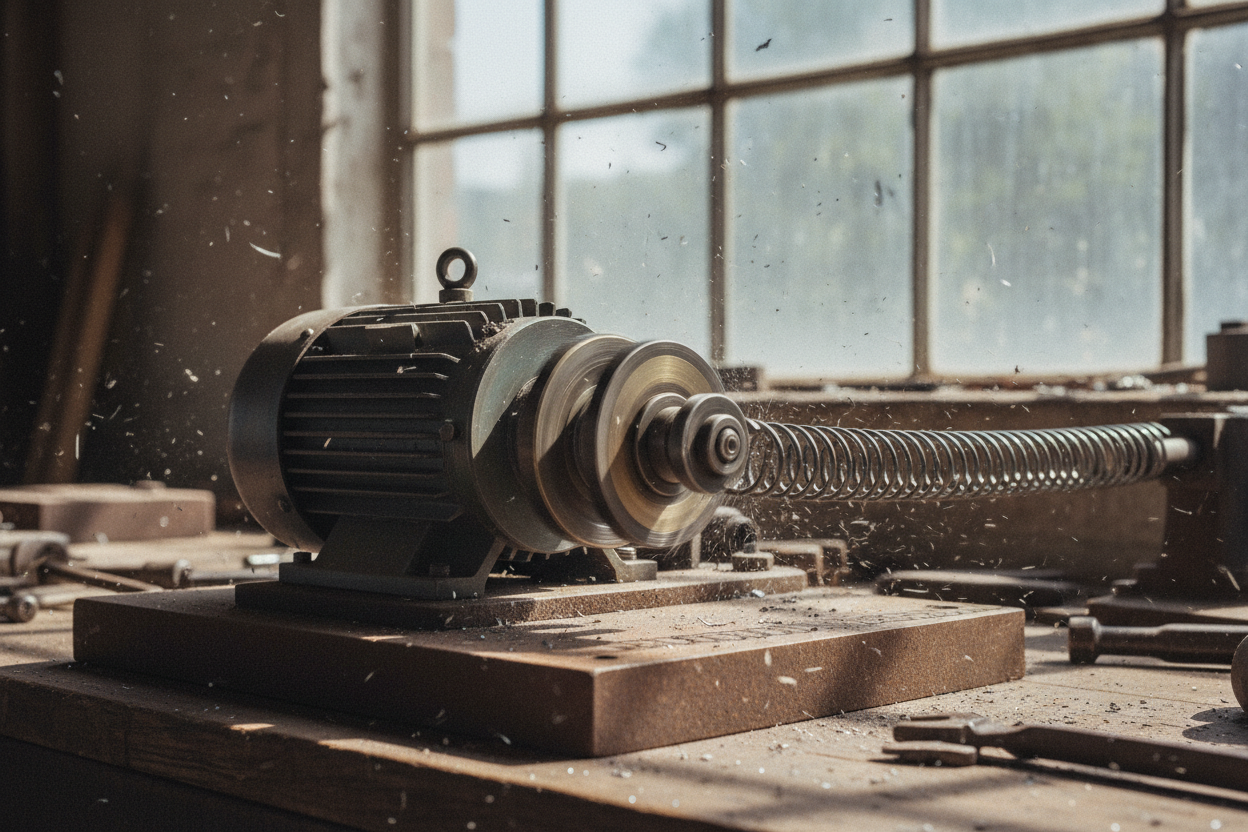
Common Mechanical Sources: Many motor problems stem from the mechanics around the shaft, bearings, and coupling. Unbalance typically shows high 1X radial vibration and improves when mass is corrected on the rotating assembly. Misalignment often produces 1X with strong 2X components, increased axial motion, and excessive heat at the coupling. Looseness creates a ragged, broadband spectrum with multiple harmonics and can originate from undersized fasteners, soft mounting pads, or fatigued bases. Bearing defects manifest as high-frequency content; applying envelope analysis reveals inner race, outer race, or rolling element fault patterns. Bent shafts, soft foot, belt resonance, and rotor rub add distinctive tones, from periodic scraping to whirring bands tied to belt speed. Validate suspicions with laser alignment, dial indicator runout checks, and torque verification. Corrective actions include precision balancing, shimming to eliminate soft foot, restoring mounting stiffness, replacing worn couplings, and re-lubricating or renewing bearings to restore smooth, predictable operation.
Electrical Causes and Signatures: Not all noise and vibration are mechanical; electrical issues can drive distinctive patterns. Voltage imbalance, harmonic distortion, and poor power quality increase electromagnetic forces and create both tonal and broadband responses. With variable frequency drives (VFDs), PWM switching can introduce a high-pitched whine and excite structural modes. Broken rotor bars and stator winding faults often produce sidebands related to slip and line frequency, sometimes modulating the 1X component. Eccentricity leads to pole-pass frequency components, while phase loss or weak connections cause overheating and torque pulsations. Electrical noise that is synchronous with electrical frequency is a key clue. Use motor current signature analysis, insulation resistance tests, and thermal scanning to differentiate electrical from mechanical causes. Proper grounding, shaft grounding brushes, and dv/dt filtering help mitigate conductive and capacitive currents that can lead to bearing fluting. Tuning VFD parameters, correcting supply imbalances, and addressing connection integrity often reduce both audible noise and structural vibration.
Measurement and Analysis Techniques: Solid data collection makes diagnosis repeatable. Place accelerometers in radial, axial, and tangential directions at the drive end and non-drive end, using rigid mounts or studs for high-frequency detail. Pair vibration with a tachometer or keyphasor for order tracking and phase analysis, essential for distinguishing unbalance from misalignment. Sample at appropriate rates, apply suitable windowing, and review both FFT spectra and time waveforms. Use envelope demodulation to uncover bearing faults, and perform bump tests or coast-down measurements to reveal resonances. Waterfall plots show how signatures evolve with speed, while cross-channel coherence and orbit plots provide deeper insight into dynamic behavior. Document mounting conditions, baseplate stiffness, nearby fans or gearboxes, and ambient influences that can contaminate readings. Repeat measurements under comparable operating points to confirm trends, and always observe safety protocols when working near rotating equipment.
Prevention, Correction, and Maintenance: The best strategy is proactive. Design and install motors on stiff foundations with proper base flatness, then perform precise laser alignment and in-situ balancing of rotors, fans, and pulleys. Implement disciplined lubrication practices, select bearings with correct clearance, and ensure seals and guards do not introduce rubs. For VFD applications, apply shielded cables, correct grounding, and use filters where needed. Add vibration isolators when structure-borne paths dominate, and avoid resonant support geometries. Build a condition-based monitoring program that trends RMS velocity, acceleration, crest factor, temperature, and bearing health indicators, with clear alarm thresholds. During troubleshooting, proceed methodically: verify mounting torque and soft foot, check balance, confirm alignment, inspect bearings, then evaluate electrical supply and drive settings. Close the loop with root cause analysis and documentation so lessons inform future decisions, preserving quiet, reliable operation across the motor fleet.