Motor Control Basics: VFDs and Controllers
Learn how Variable Frequency Drives (VFDs) and motor controllers manage speed, torque, and protection, improve efficiency, and extend equipment life.
Foundations of Motor Control — At its core, motor control is about delivering the right torque at the right speed, with the least energy and wear. For AC machines, frequency primarily sets speed while voltage supports torque. Induction motors run slightly below synchronous speed because of slip, and managing that relationship is what good control is all about. A variable frequency drive (VFD) changes the power supplied to a motor, letting you ramp, stop, and hold speed precisely. Complementary controllers coordinate starts, stops, protections, and sequencing, often supervising multiple motors in a process. You'll encounter open-loop strategies when feedback isn't required, and closed-loop methods when accuracy under varying loads matters. Smart control improves efficiency, reduces mechanical stress, and stabilizes product quality. Think of pumps, fans, conveyors, and mixers: each has different torque profiles and duty cycles, but all benefit from smoother starting, right-sized speed, and integrated protection. When designed as a system—power, control, feedback, and safety—motor control turns raw electrical energy into dependable motion.
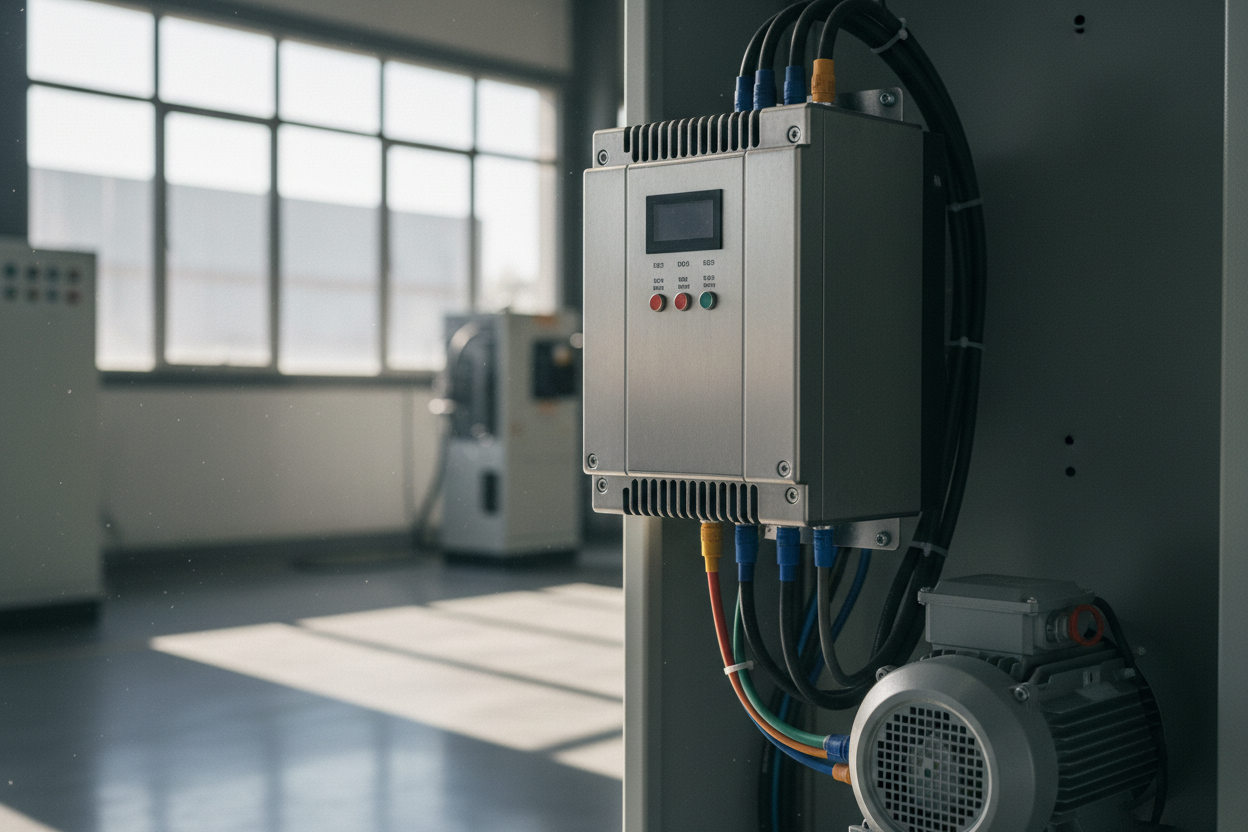
Inside a VFD — A VFD converts incoming AC to DC via a rectifier, stabilizes it on a DC bus, then recreates AC at the desired frequency and voltage through an inverter using PWM. This lets you set speed and torque with fine resolution. Two dominant control modes are scalar (V/Hz), ideal for variable-torque loads like pumps and fans, and vector control, which manages magnetic flux and torque for higher precision and faster response. Sensorless vector uses motor models to infer speed, while closed-loop vector adds an encoder for exact feedback. Built-in acceleration/deceleration ramps, S-curve profiles, and current limits protect the drivetrain. Many drives include PID control to hold pressure, flow, or tension without a separate controller. Braking options include dynamic braking with resistors or regenerative methods that return energy to the line. Expect comprehensive fault handling, such as overvoltage, undervoltage, ground fault, and overtemperature, plus parameter sets for quick commissioning and duplication.
Controllers and Starting Strategies — Not every application needs full speed variation. Direct-on-line starters keep things simple but create high inrush current and mechanical shock. Star-delta and autotransformer methods lower starting current with trade-offs in torque. Soft starters use controlled voltage ramping to ease begins and reduce stress, a great fit for fixed-speed pumps and compressors. Above that, drives deliver complete speed control and torque shaping. The wider control layer includes contactors, overload relays, and logic—either relay-based or PLC—to coordinate permissives, interlocks, and sequences. Safety-related features such as safe torque off (STO) and well-designed emergency circuits help isolate motion when required. Integration ranges from simple digital I/O and analog references to industrial networks that share setpoints, status, and diagnostics with supervisory systems. Good controller design balances protection, usability, and maintainability, ensuring operators can start, stop, jog, and recover from faults confidently while keeping processes consistent and equipment healthy.
Installation and Power Quality Essentials — Reliable motion depends on careful wiring and EMC practices. Use VFD-rated cable, keep motor leads as short as practical, and apply proper shielding and grounding to minimize radiated noise and bearing currents from high dv/dt switching. Line-side reactors or filters can temper harmonics, while output dV/dt filters or sine filters protect long cables and sensitive motors. Where regeneration or heavy deceleration occurs, select braking resistors or regenerative units sized for the duty. Consider enclosure ratings, ambient conditions, and cooling; drives and starters may need derating in hot or contaminated environments. Maintain clearances for airflow, and separate power and control wiring to reduce interference. Solid power quality mitigates nuisance trips, keeps THD in check, and extends equipment life. Document cable routes, torque terminations correctly, and validate protective device coordination. Small installation details—ground lugs, shield terminations, conduit routing—pay big dividends in uptime and predictable performance.
Tuning, Commissioning, and Optimization — Effective results start with accurate nameplate data and a guided auto-tune to characterize the motor. Set ramp times, current limits, and torque boost to match the load. For process control, use built-in PID with thoughtful tuning to avoid oscillations while meeting setpoint targets. Conveyors benefit from smooth take-up, pumps from sleep/wake logic and minimum speed limits, and fans from optimized curves that reduce noise and energy. Monitor fault logs, trending, and thermal models to preempt trouble. Periodically inspect cooling fans, filters, and capacitors, and keep a verified parameter backup for quick swaps. When integrating with a PLC or supervisory system, expose key diagnostics and alarms for faster troubleshooting. Over time, review energy usage, check alignment and vibration, and refine settings for changing loads. Clear labeling, disciplined change control, and up-to-date documentation make future upgrades painless, ensuring your motor control platform stays robust, efficient, and adaptable.