Motor Control Basics: VFDs and Controllers
Learn how VFDs and motor controllers regulate speed, torque, and efficiency, key components, selection tips, wiring, safety, and troubleshooting.
Foundations of Motor Control. Motor control is about shaping how a motor produces torque and speed to match the demands of a load. Most industrial systems rely on AC induction or permanent magnet machines, each with a characteristic torque-speed curve and efficiency profile. The relationship between electrical supply and mechanical output hinges on frequency, voltage, and the motor's number of poles, which determine synchronous speed and slip. A variable frequency drive (VFD) adjusts frequency and voltage to command speed and torque with precision, while broader motor controllers coordinate starting, stopping, protection, sequencing, and logic. Together, they transform raw electrical power into controlled motion, improving process stability and energy use. Understanding load types—constant torque, variable torque, or constant power—guides correct selection and tuning. From conveyors to pumps, the goal is consistent, efficient motion under changing conditions. By pairing the right control strategy with robust hardware, engineers reduce stress on equipment, extend service life, and enhance productivity while maintaining safe operation.
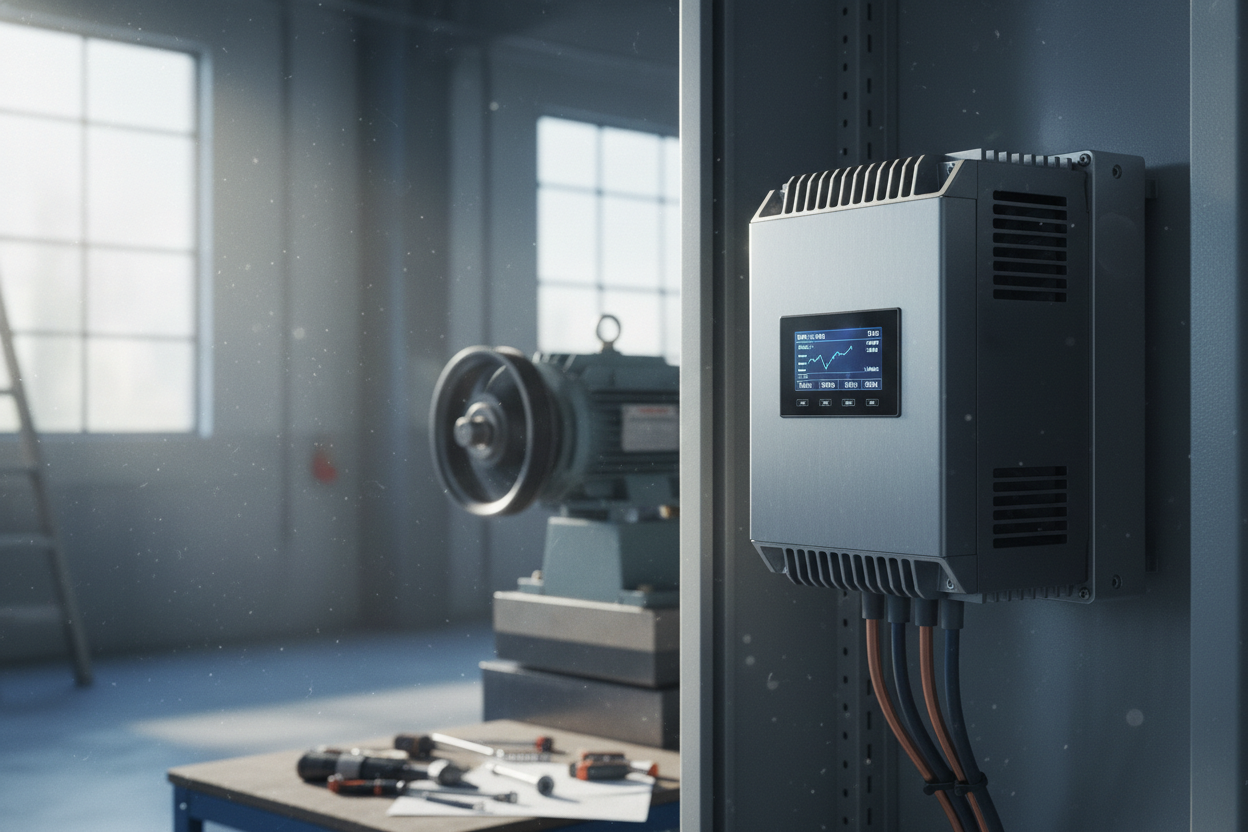
How VFDs Work. A VFD converts fixed AC input into controlled AC output through three main stages: a rectifier, a DC bus with capacitors and sometimes chokes, and an inverter that uses IGBTs to synthesize a new waveform via PWM. Control algorithms like V/Hz, sensorless vector control, and field-oriented control regulate the relationship between voltage, frequency, and flux to deliver commanded speed or torque. Variable torque applications such as fans and pumps often realize substantial energy savings because power scales with speed. Features like acceleration and deceleration ramps, braking options, and torque boost enable smooth starts, quick stops, and stable operation under disturbances. Advanced drives offer regenerative capability, feeding energy back when the load decelerates. By adapting output to real-time demands, VFDs minimize mechanical shock, reduce inrush current, and increase process precision. The result is a highly flexible platform for motion control that fits both simple and sophisticated automation scenarios.
Controllers Beyond Drives. Not every application needs a full VFD. Traditional across-the-line starters deliver fixed-speed operation but impose high inrush and mechanical stress. Soft starters temper voltage during startup, reducing current and torque transients without providing ongoing speed control. Components like contactors, overload relays, and motor protection breakers enable safe switching and protection in basic systems. At the higher end, servo drives deliver high-performance position control and rapid dynamic response for precise motion tasks, often paired with encoders. Supervisory devices such as PLCs coordinate sequencing, safety logic, and communication with drives, forming integrated cells or lines. Choosing the right controller depends on duty cycle, required precision, energy goals, and budget. For pumps and fans with variable demand, a VFD is usually ideal; for conveyors requiring gentle starts, a soft starter may suffice; for robotics or indexing tables, a servo solution shines. The key is matching control depth to the process while ensuring protection, maintainability, and scalability.
Control Modes and Feedback. Control strategies span open-loop and closed-loop modes. In open-loop, a VFD follows a V/Hz or estimated flux profile to regulate speed without direct feedback, suitable for many pumps and fans. Closed-loop control adds an encoder or resolver to measure shaft speed or position, enabling high accuracy, torque at zero speed, and fast disturbance rejection. A PID regulator often ties setpoints to process variables such as pressure or flow, with ramp profiles and S-curve shaping to limit mechanical stress. Features like slip compensation, torque limits, and auto-tuning enhance stability under changing loads. Stopping methods include coast, DC injection, dynamic braking, and regenerative braking, each balancing heat, wear, and energy recovery. Robust parameter sets define min and max speeds, acceleration, deceleration, and braking thresholds. Well-chosen feedback devices, filters, and loop settings translate into smoother processes, tighter tolerances, and greater energy efficiency across diverse duty profiles.
Sizing and Installation. Proper sizing starts with the motor nameplate: voltage, kilowatt or horsepower, full-load current, base frequency, and speed. Define the load profile—constant torque, variable torque, or constant power—and consider overload requirements, duty cycles, and starts per hour. Environmental factors such as ambient temperature, altitude, dust, and moisture drive derating and enclosure choices. Long motor leads may require a dV/dt filter or sine-wave filter to protect insulation and reduce stress. A line reactor or DC choke can mitigate harmonics and improve ride-through. Use properly sized, low-capacitance, shielded cables, correct grounding, and segregated conduits to control EMI. For high-inertia loads, select a braking resistor and ensure adequate thermal capacity. Plan for clearances, cooling airflow, and easy access to terminals and the keypad or fieldbus ports. Good installation practice reduces nuisance trips, enhances reliability, and simplifies future maintenance and expansion.
Safety and Protection. Effective systems employ layered protection: overcurrent, short-circuit, overvoltage, undervoltage, phase loss, ground fault, stall, and thermal protection guard the drive and motor. Motor thermistors or RTDs provide direct temperature feedback for precise overload response. Functional safety features like Safe Torque Off (STO) help prevent unintended motion during maintenance or emergency stops, while external interlocks and isolation contactors ensure safe work conditions. Thoughtful e-stop design coordinates with drive deceleration and mechanical brakes to achieve predictable stop categories. Thermal management—clean filters, operational fans, clear heat sinks, and proper spacing—sustains longevity. Periodic inspection of terminals, capacitors, and cooling paths reduces unexpected downtime. Clear fault logs and alarm hierarchies guide rapid recovery. By uniting electrical protection with procedural safeguards, teams protect personnel, machinery, and product quality, ensuring consistent uptime and a resilient control environment.
Tuning and Troubleshooting. Successful commissioning relies on accurate parameters and systematic auto-tune routines, either static or rotational, to capture motor resistance, inductance, and flux data. Validate rotation, feedback polarity, and scaling before closing loops. If instability appears, review PID gains, ramp rates, and torque limits, and verify slip compensation or vector model settings. Electrical noise can corrupt feedback; improve shielding, grounding, and encoder power. Excess harmonics may demand line reactors or filters, while audible whine or mechanical resonance can be mitigated with switching frequency adjustments or mechanical damping. Watch for bearing currents and use shaft grounding where needed. Trend fault codes, temperature, and bus voltage to spot patterns, and document setpoints and firmware baselines for repeatability. A disciplined approach—measure, change one variable, re-test—reveals root causes quickly. With good records and proactive monitoring, teams sustain peak performance, reduce energy use, and minimize unplanned downtime across the motor fleet.