Inside a Brushless Motor: Components and Benefits Explained
Discover how BLDC motors work: rotor magnets, stator windings, sensors, and an ESC deliver high efficiency, precise control, long life, and low maintenance.
What makes brushless motors different: In the broad world of motors, the brushless design has become a go-to choice for efficiency and control. A brushless motor replaces mechanical commutation with electronic commutation, using a stator with energized windings and a rotor that carries permanent magnets. As the controller sequences current through the stator phases, it creates a rotating magnetic field that pulls the rotor into alignment, generating torque without brushes, friction, or sparks. This architecture boosts efficiency, raises power density, and reduces maintenance, because the heat-producing windings are fixed to the housing and can be cooled more effectively. The result is smooth speed control, strong low-end torque, and consistent performance across a wide operating range. From compact devices to larger machinery, brushless motors deliver a compelling blend of reliability, precision, and quiet operation, making them a standout in the motors category for applications that demand long life, rapid response, and predictable behavior under variable loads.
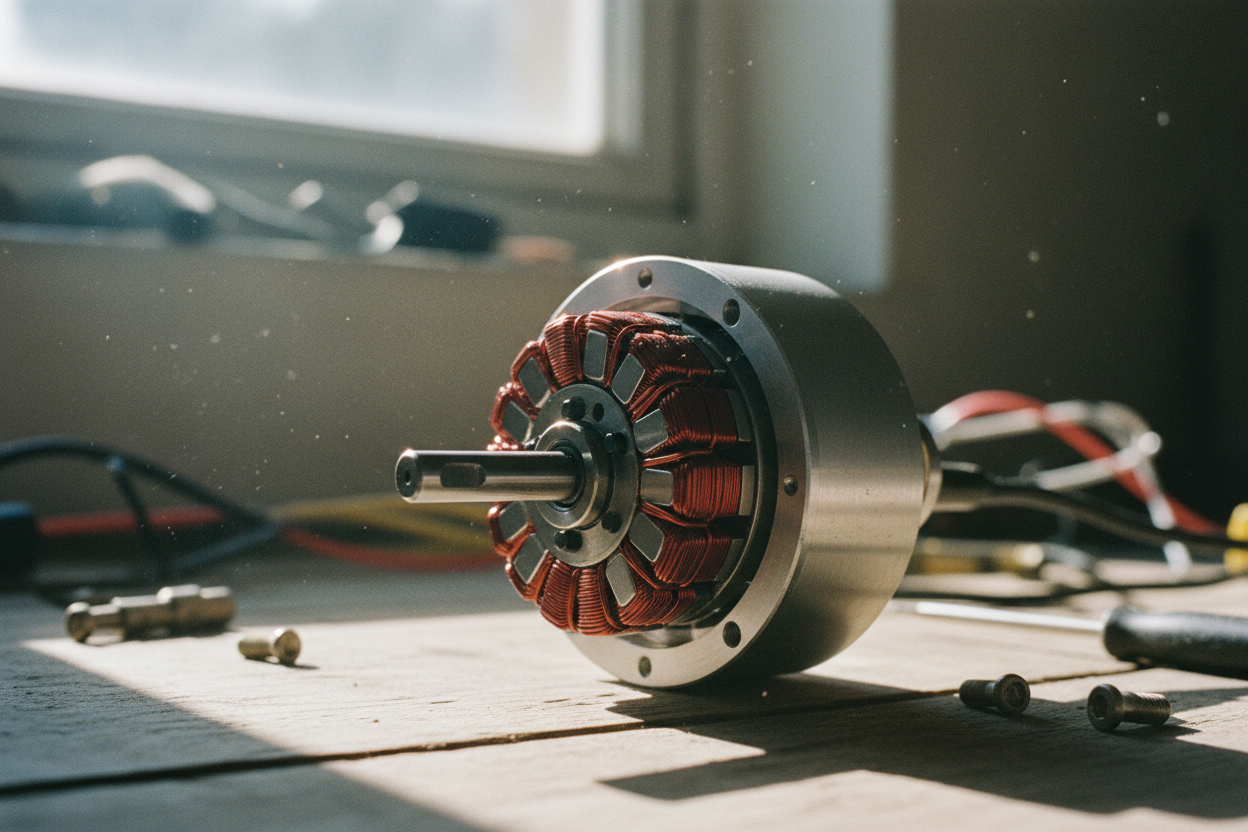
Inside the stator windings: The stator forms the stationary backbone of a brushless motor, typically built from laminated steel to minimize eddy current losses. Around its slots sit copper windings arranged in multiple phases, most commonly three, which are energized in a specific sequence to generate a rotating field. Designers choose distributed or concentrated windings to shape torque ripple, cogging, and overall performance. Connection schemes such as wye or delta influence current and voltage characteristics, helping match the motor to a given controller and power source. High slot fill, robust insulation, and quality impregnation or potting improve thermal paths and vibration resistance, raising the motor's continuous rating. Subtleties like slot skew, tooth geometry, and magnetic circuit optimization further refine smoothness and acoustic behavior. Because the stator is fixed to the frame, it sheds heat efficiently through the housing, enabling higher continuous torque without compromising lifespan—one of the core reasons brushless machines excel in demanding duty cycles within the motors category.
Rotor and magnet topologies: The rotor carries permanent magnets that interact with the stator's field to produce motion. Two common arrangements are surface-mounted magnets, which deliver high back-EMF and fast response, and interior permanent magnet designs, which embed magnets in the rotor to enhance saliency, improve field weakening, and widen the speed range. Engineers manage mechanical stresses with retaining sleeves, adhesives, and careful balancing, ensuring magnets remain secure at high rpm while keeping inertia low for crisp acceleration. Magnet segmentation can reduce eddy current losses, and rotor shapes are tuned to control torque ripple and acoustic traits. The choice of magnet grade, geometry, and retention method affects thermal robustness, resistance to demagnetization, and long-term reliability. These decisions, coupled with the stator design, define the motor's torque constant, efficiency, and peak capability, showing how rotor architecture is central to performance in the motors category where speed, torque, and durability must coexist.
How electronic commutation works: At the heart of a brushless system is the electronic speed controller that performs commutation using power switches such as MOSFETs or other transistors. By applying pulse-width modulation to the three phases, the controller regulates voltage, current, and torque. Position feedback comes from Hall sensors or sensorless methods that estimate rotor angle from back-EMF, letting the controller align stator fields with rotor magnets. Simple trapezoidal control is efficient and robust, while field-oriented control generates sinusoidal currents for ultra-smooth torque and reduced losses. Modern loops manage phase current, speed, and sometimes position, blending responsiveness with protection features like current limiting and thermal derating. Proper timing reduces torque ripple and improves efficiency, and synchronous rectification cuts conduction losses. Together, these strategies turn raw electrical power into precisely metered mechanical output, unlocking the hallmark precision and controllability that make brushless motors so effective across the motors category.
Benefits that move the needle: Brushless motors deliver a compelling list of advantages that extend beyond headline efficiency. With no brushes to wear, they offer exceptional longevity and minimal maintenance, critical for continuous or hard-to-access installations. Their high power-to-weight ratio supports compact designs without sacrificing torque, while cooler-running stator windings improve thermal stability and continuous output. Smooth torque production reduces vibration and noise, improving user experience in precision equipment and comfort-focused systems. Precise speed regulation, wide dynamic range, and fast transient response make them easy to pair with advanced controls for nuanced motion profiles. They also support regenerative braking in appropriate drives, recapturing energy during deceleration. From small devices to industrial-grade machines, these traits coalesce into lower total cost of ownership, higher reliability, and consistent performance—benefits that make brushless technology a smart default in the motors category when accuracy, durability, and energy savings matter.
Selecting and integrating the right motor: Getting the best from a brushless system starts with correct sizing. Map the load profile to determine continuous and peak torque, then choose a motor whose torque constant and thermal capacity fit the task. Remember that Kv and Kt are inversely related, so a lower Kv generally yields higher torque per amp at a given voltage. Match the voltage and current to the controller, leaving margin for overloads and cooling realities. Consider duty cycle, ambient conditions, IP protection, and bearing type. Pay attention to inertia matching for responsive control, and select FOC-capable drives when low noise and smoothness are priorities. Good integration practices—short, appropriately gauged phase leads, solid grounding, EMI-conscious layout, and adequate airflow or heatsinking—preserve efficiency and reliability. Calibrate sensor alignment, verify commutation timing, and tune current limits to protect both motor and electronics. With thoughtful selection and setup, a brushless motor delivers enduring, high-performance motion in the motors category.