Hybrid and Electric Drivetrains: How Power Reaches the Wheels
From engines and inverters to motors, clutches, and gears, explore how hybrid and electric drivetrains convert energy into torque that reaches the wheels.
Power at Its Core Electric and hybrid drivetrains transform stored energy into motion by guiding torque through a carefully orchestrated chain of components. In pure electric designs, energy flows from a battery to an inverter, then to an electric motor that spins through a reduction gear and differential before reaching the tires. Hybrids add a combustion engine, plus clutches and gearsets that blend power seamlessly with the motor. Regardless of the layout, the story is the same: convert energy efficiently, manage heat, and deliver smooth, predictable wheel torque under every condition. The magic lies in coordination. Power electronics modulate current with millisecond precision, while control software interprets pedal input, traction data, and battery limits to choreograph how power reaches the road. Meanwhile, regenerative braking turns kinetic energy back into electricity, closing the loop and improving efficiency. From city creep to highway passing, modern drivetrains prioritize responsiveness, efficiency, and refinement, shaping how motors, gears, and controllers translate energy into confident forward motion.
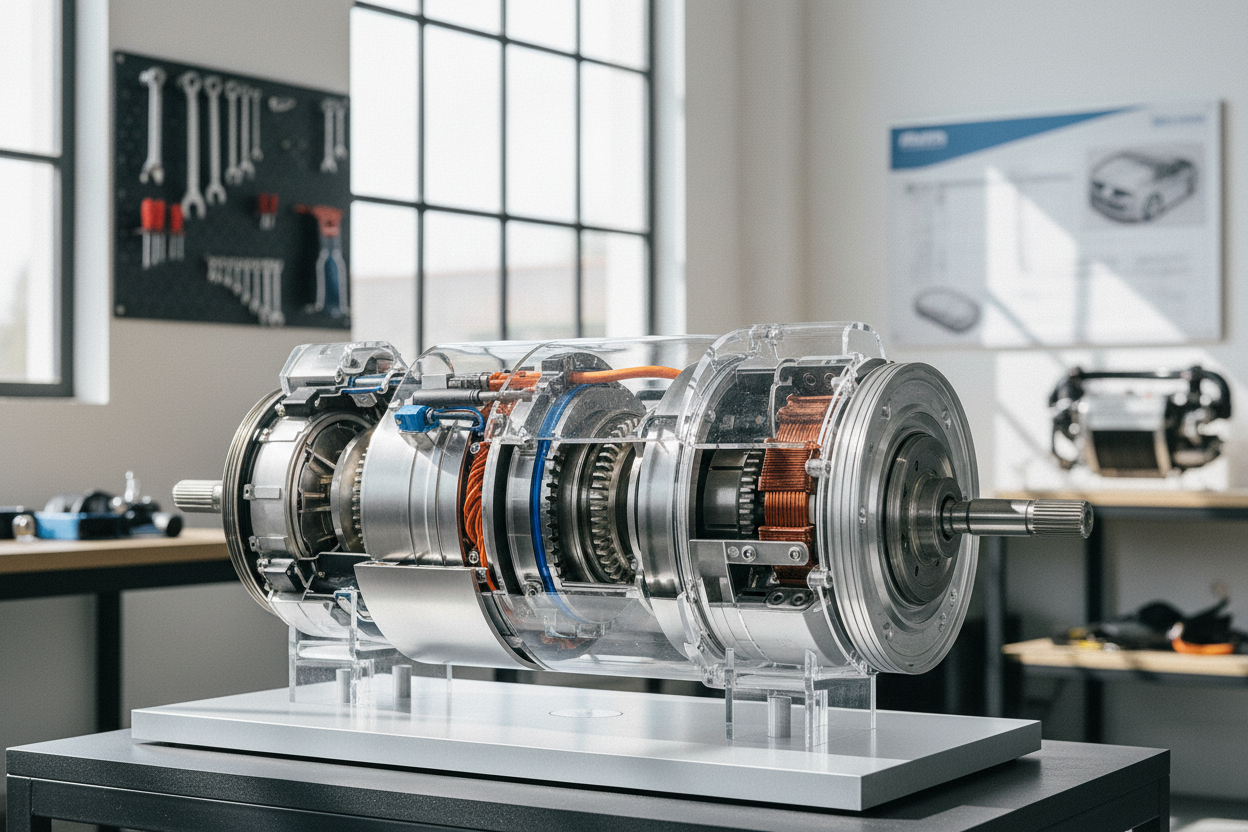
Inside an Electric Drivetrain In an electric drivetrain, the battery pack stores DC energy, the inverter converts it to AC, and the motor creates rotational force. Common motor architectures—permanent-magnet synchronous, induction, and synchronous reluctance—differ in magnet usage, efficiency, and thermal behavior, but all deliver instant low-speed torque and broad power bands. Most electric vehicles rely on a single fixed reduction gear, eliminating multi-speed shifting and ensuring consistent performance with fewer moving parts. Under acceleration, electrons flow from the battery to the inverter and into the motor's stator; under regenerative braking, that flow reverses as the motor acts as a generator, sending energy back to the battery. A battery management system (BMS) oversees cell balancing and state of charge, while thermal management stabilizes temperatures across the battery, inverter, and motor to protect durability and sustain output. The result is a compact, efficient path from electrons to axle torque, delivering a driving feel that is smooth, quiet, and responsive across varied conditions.
Hybrid Architectures Explained Hybrids connect an engine and an electric motor in three main layouts: series, parallel, and series-parallel (power-split). In a series hybrid, the engine never drives the wheels directly; it spins a generator that powers the motor or charges the battery, making the motor the sole source of wheel torque. Parallel hybrids allow both engine and motor to drive the wheels, either alone or together, with clutches coordinating handoffs for efficiency or performance. The series-parallel approach blends both ideas using a planetary gearset as a power-split device, routing engine torque mechanically, electrically, or both depending on speed, load, and battery status. Control strategies decide when to run in EV mode, when to use the engine for cruising, and when to combine sources for peak output. By dynamically optimizing energy flow, hybrids reduce fuel use in stop-and-go traffic while retaining strong highway capability, giving drivers the benefits of electrified torque without sacrificing long-range practicality.
The Role of Energy Management Modern drivetrains are defined by control algorithms that transform driver inputs and road data into coordinated torque at each axle. Accelerator position becomes a desired torque curve, filtered by state of charge (SoC), component temperatures, and traction availability. During deceleration, brake blending apportions stopping force between regenerative braking and friction brakes, maximizing energy recovery while keeping pedal feel natural. The system also manages cooling circuits for the battery, inverter, and motor, preserving performance during steep climbs, hot weather, or repeated accelerations. In hybrids, engine start-stop events are synchronized with e-motor torque fill to make transitions imperceptible. Predictive energy management can look ahead to hills or traffic patterns, adjusting SoC targets and power delivery to minimize waste. Modes such as eco, normal, and sport reshape throttle mapping, regen strength, and shift logic (where applicable), tailoring the power path to driver preference while safeguarding reliability and long-term component health.
From Axles to Asphalt The final leg of power delivery lives in e-axles, differentials, and driveshafts that translate motor output into controlled wheel rotation. Many electric setups integrate motor, inverter, and reduction gear into a compact unit, minimizing losses and simplifying packaging. Single-motor configurations feed a central or axle-mounted differential, while dual-motor layouts enable all-wheel drive without a traditional transfer case. With independent front and rear motors, software can perform torque vectoring, overdriving an outside wheel or reducing inside-wheel torque to sharpen handling and improve stability. Even within a single axle, electronically controlled differentials can limit slip for better traction on low-grip surfaces. Designers balance gear ratios for brisk launches and efficient cruising, while careful attention to NVH (noise, vibration, harshness) ensures quietness without dulling feedback. By uniting precise torque control with smart mechanicals, modern drivetrains convert electrical or blended engine power into clean, confident propulsion suited to every surface and season.
Practical Considerations and Outlook Electrified drivetrains reduce maintenance by eliminating items like multi-speed transmissions and exhaust systems, yet they still rely on gear oil, coolant, and filters to keep components healthy. Battery and inverter temperatures must be managed carefully, especially during rapid accelerations or extended climbs. Cold weather can limit regen and reduce available power, while heat can prompt protective strategies; robust thermal designs and software updates help maintain consistency. For towing or sustained high loads, systems may adjust torque delivery to protect components and manage SoC. Owners benefit from smooth one-pedal driving, quick response, and quiet operation, while technicians use diagnostics to monitor cell balance, motor insulation, and inverter performance. Looking ahead, tighter integration of drive units, smarter energy management, and advanced torque vectoring promise even more efficient, compact, and responsive systems. The core mission remains unchanged: deliver the right torque to the right wheel at the right time, with minimal losses and maximum driver confidence.