Common Motor Failures and How to Prevent Them
Learn the most common motor failures—overheating, bearing wear, insulation breakdown, misalignment, and contamination—and practical steps to prevent them.
Overheating and Thermal Stress
Excess heat is one of the quickest ways to shorten a motor's life. Common drivers of overheating include overloading, poor ventilation, blocked cooling paths, high ambient temperature, frequent starts and stops, and voltage imbalance. Heat accelerates insulation aging, dries out lubricants, and distorts components, leading to cascading failures. Prevention starts with correct motor sizing for the mechanical load and duty cycle, ensuring fans, shrouds, and cooling fins remain clean and unobstructed. Use thermal protection such as embedded sensors, overload relays, and smart monitors to detect rising temperatures early. If using VFDs, configure appropriate acceleration times to limit inrush current and reduce thermal stress. Implement derating in harsh environments, improve airflow around enclosures, and avoid operating continuously near nameplate limits. Schedule periodic cleaning to remove dust and oil film that insulates heat. Validate the actual load with current measurements and compare to the motor's rated current, adjusting process demands when needed. Proactive temperature control preserves insulation, bearings, and overall motor efficiency.
Bearing Failures and Lubrication Practices
Most mechanical motor failures trace back to bearings. Root causes include improper lubrication, contamination, misalignment, belt over-tension, and electrical erosion from shaft currents. Early symptoms often appear as increased vibration, rising temperature, or louder operating noise. To prevent damage, follow the manufacturer's greasing intervals, use the correct grease type and quantity, and keep fittings and housings clean during application. Over-greasing can cause churning and heat, while under-greasing leads to metal-to-metal contact. Protect against contaminants with effective seals, proper cable entries, and clean surroundings. For VFD-driven systems, consider insulated bearings and shaft grounding to mitigate circulating currents. Maintain precise alignment and correct belt tension to avoid radial loads that shorten bearing life. Store spares in a clean, dry place and rotate shafts periodically to prevent false brinelling. Employ vibration analysis and acoustic monitoring to catch defects early. A disciplined lubrication program dramatically extends bearing reliability and safeguards the entire rotor assembly.
Insulation Breakdown and Winding Faults
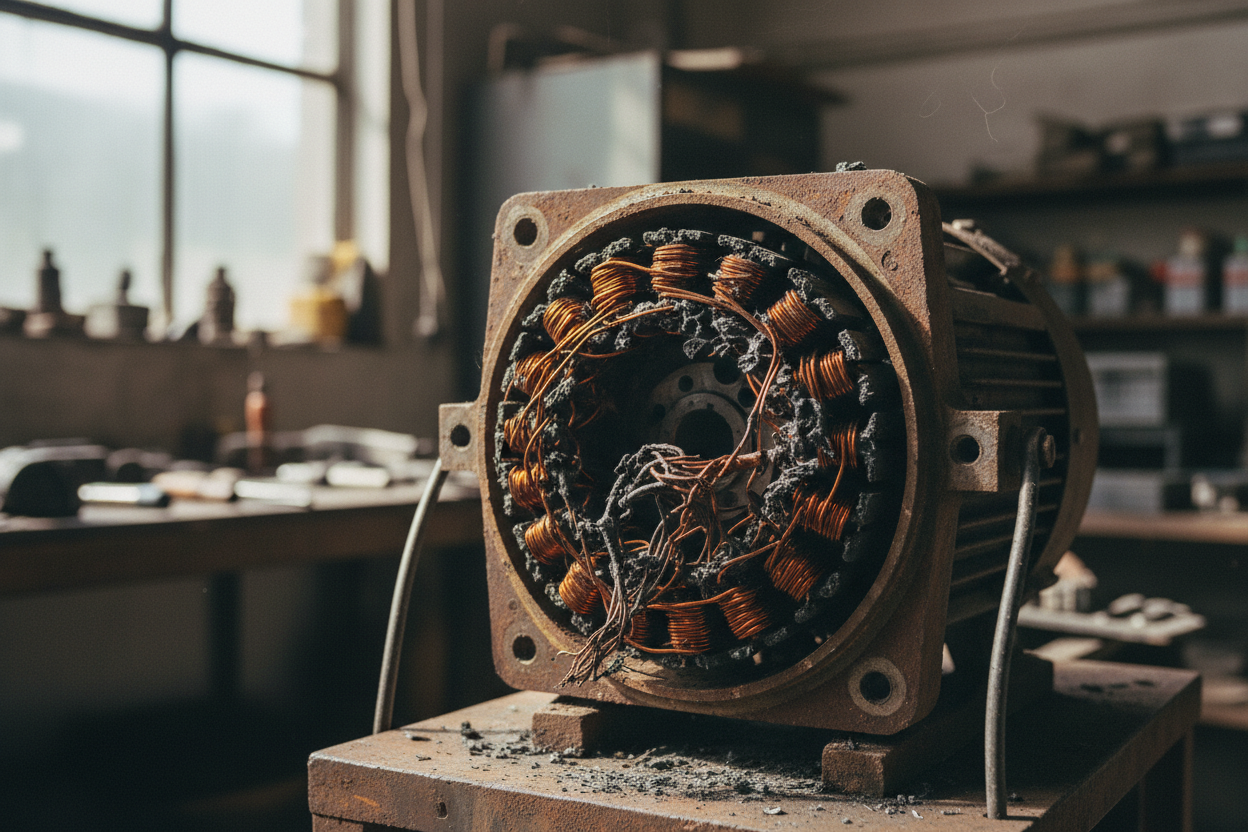
Electrical failures often begin as minor insulation degradation that progresses into winding shorts, turn-to-turn faults, or complete stator damage. Contributing factors include excessive heat, moisture, dust and oil contamination, poor terminations, voltage spikes, and steep dv/dt from drives. Once insulation loses dielectric strength, minor defects can escalate under electrical stress and vibration. Prevention starts with keeping motors clean and dry, using space heaters or controlled environments where condensation is likely. Conduct regular insulation resistance and polarization index testing to track deterioration trends, and consider surge testing for critical units. When applying VFDs, select appropriate cable types, minimize cable length where practical, and add dv/dt filters or line reactors if the application demands. Ensure tight, properly torqued terminations to prevent hot spots. Choose insulation thermal classes that match your ambient and duty cycle, and avoid frequent hot restarts. Document test results to establish baselines and identify small declines early. Strategic cleanliness, moisture control, and thoughtful drive integration preserve winding integrity and boost long-term reliability.
Power Quality, Phase Issues, and Protective Devices
Poor power quality silently undermines motors. Voltage unbalance, phase loss, undervoltage, and overvoltage increase current in one or more phases, elevating heat and reducing efficiency. Harmonics from nonlinear loads can further elevate losses and torque ripple, while nuisance tripping masks underlying issues. Prevention requires robust protective devices: phase-monitor relays, adjustable overload relays, ground-fault protection, and proper short-circuit coordination. Use adequately sized conductors to limit voltage drop, ensure solid grounding, and apply surge protection to guard against transients. For VFD applications, consider line reactors, isolation transformers, or harmonic mitigation when facility distortion is high. Periodically log voltage and current to spot trends; even small unbalances can require derating to prevent overheating. Verify tight connections at starters, contactors, and terminal boxes to avoid resistive heating. Calibrate protection settings to match motor nameplate data and real operating conditions. With steady, clean power and well-configured protection, motors deliver consistent torque, improved efficiency, and fewer unexpected trips or thermal events.
Misalignment, Soft Foot, and Mounting Integrity
Mechanical alignment is crucial for motors driving pumps, fans, conveyors, and compressors. Misalignment and soft foot create excessive vibration, heat, and bearing loads, accelerating wear on couplings and seals. Poor baseplate flatness, inadequate grouting, or pipe strain transmitted into the machine can distort frames and shift alignment shortly after commissioning. Prevention begins with solid foundations, properly shimmed feet, and stress-free piping. Use laser alignment or high-quality dial methods to achieve precise angular and parallel alignment, verifying after thermal stabilization when applicable. Check for runout, bent shafts, and coupling condition, and select couplings that match torque and misalignment tolerances. Balance rotating components to minimize excitation of structural resonances, and correct looseness in guards or mounts that amplify vibration. Document alignment targets and re-verify after maintenance or process changes. By controlling installation quality and mounting integrity, you reduce energy losses, protect bearings, and significantly extend the service life of driven equipment and the motor itself.
Environment, Contamination, and Predictive Maintenance
Harsh environments can rapidly degrade motors through dust, moisture, chemicals, and temperature extremes. Ingress of particulates or water compromises insulation, clogs cooling fins, and pollutes lubricants. Choose enclosures and IP ratings suitable for the setting, maintain effective seals, and ensure clean air intake paths. Manage condensation with space heaters, desiccant breathers, or controlled storage practices. Establish a disciplined preventive maintenance plan that includes cleaning, torque checks, airflow inspection, and functional tests. Augment it with predictive maintenance techniques: vibration analysis, infrared thermography, ultrasound for air leaks or arcing, and motor circuit analysis to detect hidden electrical issues. Keep detailed records to spot patterns and tie alarms to actionable thresholds. Train operators to recognize abnormal sounds, smells, and temperatures, and to report them promptly. For spares, store in stable conditions and rotate shafts to prevent damage. A culture of cleanliness, documentation, and early detection transforms motor care from reactive to reliability-centered, reducing downtime and total lifecycle cost.