Brushed vs Brushless: Which Motor Type Fits Your Build?
Brushed vs brushless: weigh cost, control, efficiency, power, and maintenance to pick the motor that fits your budget, tools, and performance goals.
Basics and Operating Principles
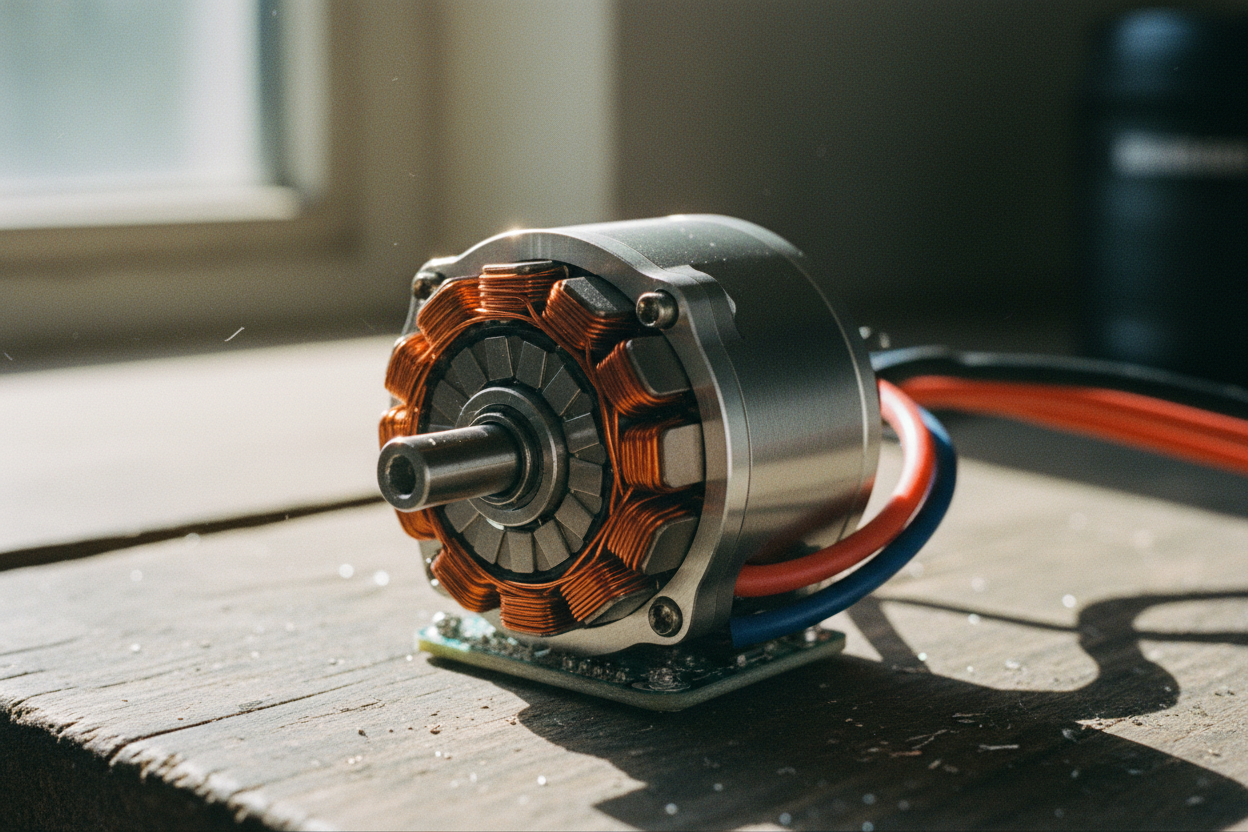
If you're choosing between brushed and brushless motors, start with how each converts electrical energy into motion. A brushed DC motor relies on carbon brushes and a commutator to switch current through the rotating armature, which makes wiring simple and control straightforward. In many cases, you can drive a brushed motor with a basic H-bridge and PWM, and it will deliver predictable behavior with minimal setup. A brushless motor moves commutation to electronics: windings live on the stator, permanent magnets ride on the rotor, and an ESC coordinates phase switching using Hall sensors or sensorless back‑EMF. This architecture removes mechanical wear parts, enables higher speed, and improves efficiency. Common form factors include inrunner (high RPM) and outrunner (higher low‑speed torque). Spec sheets often list Kv (speed per volt) and Kt (torque per amp), which are inversely related. In short, brushed favors simplicity and immediate deployment, while brushless favors precision, power density, and scalability—provided you budget for the controller and tuning.
Efficiency, Power, and Torque
When efficiency matters, brushless usually wins. Brush friction and commutator arcing waste energy as heat in brushed motors, especially at higher speeds and loads. Brushless designs eliminate that contact loss, leaving mainly copper (I²R), iron, and switching losses in the windings and ESC. For torque, both types follow the relation torque ≈ Kt × current; however, brushless motors can maintain torque with better thermal management because heat forms in the stator, which is easier to heatsink. Brushed motors concentrate heat in the rotor, making continuous heavy loads riskier without aggressive cooling. At very low speeds, a brushed motor provides smooth startup torque with simple PWM, while a sensorless brushless setup may cog unless paired with a sensored ESC or advanced startup algorithms. For high RPM, sustained power, and superior power‑to‑weight, brushless is difficult to beat. Consider inertia too: an outrunner's larger rotating mass smooths output but can slow response, whereas an inrunner spins faster with crisp acceleration when geared appropriately.
Control, Noise, and Maintenance
Control depth differentiates these motors in practice. Brushed units are easy: a modest H‑bridge, PWM, and optional current limiting produce reliable speed and torque control, with minimal configuration. Brushless shines with an ESC that offers timing, PWM frequency, braking strength, and even FOC for ultra‑smooth low‑speed torque and quiet operation. Sensored brushless systems enhance low‑RPM control and eliminate cogging; sensorless saves weight and cost but may struggle at crawl speeds. On noise, brushed motors generate mechanical and electrical noise from brush contact, plus EMI that can affect sensitive electronics. Brushless noise stems mainly from switching harmonics and bearings, often easier to manage with proper filtering and layout. Maintenance is another divider: brushed motors require periodic brush replacement and commutator care, making them consumables under heavy duty. Brushless motors have fewer wear points—primarily bearings—delivering longer reliability with minimal upkeep. For environments sensitive to sparks, brushless operation and sealed construction are clear advantages.
Cost, Availability, and Build Complexity
For tight budgets and rapid prototypes, brushed motors excel: they're inexpensive, widely available, and run with low‑cost drivers. The total bill remains small, and wiring is simple. Brushless systems often cost more once you include a capable ESC, sensors if needed, and time spent on configuration, but the payoff comes in efficiency, longevity, and performance. Build complexity also differs. Brushless wiring involves three phases, correct phase order, and signal integration; ESCs may require throttle calibration, arming routines, and failsafe setup. Consider power delivery too: voltage range, surge current, and BMS or fuse protection. Thermal pathways matter—brushless stators can be coupled to chassis heatsinks, while brushed rotors challenge cooling. Environmental demands should influence choice: dust, moisture, and vibration can accelerate brush wear, while sealed brushless designs better handle harsh conditions. Factor in connectors, mounting geometry, gearing vs direct drive, and service access. In many builds, the higher initial effort of brushless repays itself in reduced maintenance and higher overall system efficiency.
Use Cases and Decision Checklist
Match the motor to your priorities. Choose brushed for simplicity, low upfront cost, quick iteration, and reliable low‑speed behavior without complex controllers. It's a strong fit for small mechanisms, intermittent duty actuators, and projects where convenience and serviceability trump ultimate efficiency. Choose brushless when you need maximum runtime, sustained power, high efficiency, and superior thermal performance—ideal for aerial platforms, high‑speed drives, precision motion with FOC, and compact builds that demand high power density. Weigh key factors: available voltage and current, required torque and duty cycle, thermal constraints, acoustic and EMI limits, maintenance access, controller ecosystem, and your tolerance for tuning. Space and weight often tip the scales toward brushless, while extremely tight timelines or educational builds often favor brushed. If you can invest in an ESC and setup time, brushless typically delivers the best long‑term value. If you need motion now with minimal overhead, brushed remains a dependable, no‑nonsense choice.